Tuesday, 24 June 2014

GUEST BLOG - 24th June 2014 - Mark Meynell


The Recovering Greenness of a Shrivelled Heart:

Thoughts on Rachel Kelly's Black Rainbow 
Rachel Kelly is spot on: “But in the end, depression doesn’t follow rules: it is a devil that comes in many guises.” (Black Rainbow, p231) So there is a sense in which her experiences of depression (two highly debilitating and bewildering attacks and the subsequent need to manage it) will inevitably be unique. But her new Black Rainbow is remarkable: for it is no misery memoir but an act of generosity. In making herself vulnerable through talking so openly about facing and working through deeply personal pains, she has offered nothing less than a gift of grace. For in the midst of the bleak, black, barrenness of depression, she has found a path through. For those of us perhaps further back along the road, this is a germ of hope.
I’ve read quite a few books on the subject, inevitably. It is also a subject to which I’ve returned on this blog more than once. Of the books by those who have been through it, this will now be my first lending book alongside William Styron’s Darkness Visible. For the secret of her path to recovery, or perhaps equilibrium is a better word, has been words. Or more specific, the weighty words of others who understand. Or at least others who can articulate a moment, a sense, a fear.
Kelly - Black RainbowHaving wrestled the black dog for perhaps almost 10 years now, one of the biggest stresses for me (especially in the first few years) was the absence of words. I simply could not articulate what was happening to me. And because words are my life at so many levels, this was particularly terrifying. When I started counselling, I was naturally asked what I hoped to get out of it. I had no illusions about talking therapies bringing cures – I simply needed words. Not so much for others’ sake but for my own.

The Words of Kindreds

One of the toughest things about this affliction is its invisibility. Some actually appear not even to believe in its reality. There are no slings, crutches or scars that prove it.
Depression offers no such measurable proofs. Even its victim may wonder if they really do have an illness. (p133)
There are only the withdrawals, the monosyllables, the distant eyes. Others’ scepticism merely serves to deepen the self-doubt of the depressive. So kindred spirits who don’t question the validity or reality of the pain are crucial. Kelly describes how she deepened her “bonds with the tribe who understood what a depressive illness was, some of whom I had known for years without realising that they had struggled in this way.” (p137) But sometimes, the company of friends is even too much – but thankfully, solitude need not bring isolation. For here the printed word comes into its own.
A history grad who became a journalist with The Times, Rachel had been brought with a deep affection for poetry, and this stood her in good stead. The book’s subtitle is “How words healed me: my journey through depression”. And so as she retells her story with agonising candour, she intersperses it with poems or even just snippets of verse which helped her or captured a moment.
So poetry’s brevity was a blessing. I wasn’t alone, others had suffered and made something of their suffering. They had re-ordered the seemingly random cruelty of the illness into some kind of sense. (p73)
Drury - Music at midnightOne of her favourites was George Herbert – and coincidentally I had just finished John Drury’s simply wonderful book on Herbert’s life and poetry, Music at Midnight. Herbert had himself asked for his manuscript of poems to be printed posthumously (by his old friend Nicholas Ferrar of Little Gidding) in the hope that they would bring some “consolation of any dejected poor soul.” (Drury, p19) This hope was clearly realised for Rachel, and through her consolation, for me too. The sublime perfection of Herbert’s “Love (III)” is a case in point. But as she says:
I would also repeat endlessly certain phrases and images from ‘The Flower’, another Herbert poem. One of my favourites was ‘Grief melting away/like snow in May’: I wrote it out on a Post-it note and stuck it on the bathroom mirror, as I had done with key facts when revising for my history finals a decade previously at Oxford. It felt equally urgent. Two other favourite lines were ‘Who would have thought my shrivelled heart / could have recovered greenness?’ (p78)
The therapeutic power of others’ words goes further, though. As she begins to read more, including novels, she describes a kind of victorious circle that follows:
Being able to read is not just a sign of returning concentration and that you are getting better. It can actually help your recovery: reading triggers that part of the brain that governs empathy and liberates you from your own personality by connecting you to others. While I was absorbed in the dramas of Cassandra, Rose and Topaz, I was rescued from thinking only about myself. The more connected I felt to others, the more stable I felt in turn. (p101)
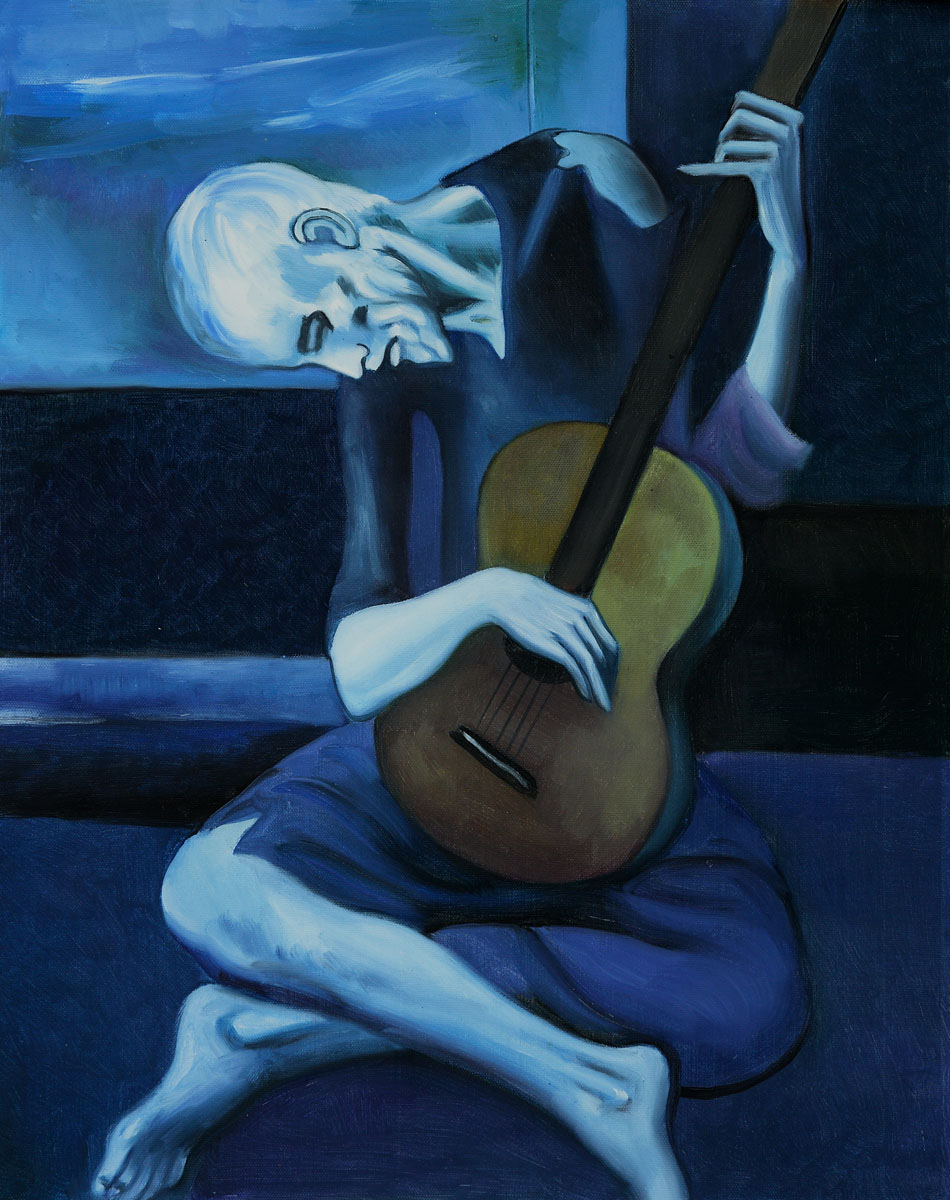
The Old Guitarist (Picasso, 1903-4)
I have long loved fiction particularly for this precise reason.
But there were many other reasons why I valued this book so much. Here are two:

The Pains of Depression

I loathe the word depression. When Rachel started sinking, it would never have occurred to her to call it depression. So her psychiatrist needed to unpick the vocabulary.
On his next visit, Dr Fischer explained that depression is an umbrella term covering many different types of emotional or mood disorders. The term itself is misleading, as it has become commonplace to say ‘I feel depressed’ as a proxy for feeling briefly gloomy. ‘It may be easier to use the phrase ‘depressive illness’ as a way to distinguish depression from ordinary sadness,’ he said. (p59)
This is exactly what Styron was on to. One of the most perplexing aspects, though, was its physicality. There was nothing to see, and yet…
Nor had a realised the intensely physical nature of depression. As I told Dr Fischer, I had thought it was a case of lying around in a vaguely disconsolate mood and had absolutely idea that it could make you feel physically ill. Yes, he agreed, it was a common misconception. But mind and body are indissolubly linked. No human activity can be said to be wholly physical or wholly mental; all human activity, in whatever sphere, is psycho-physical. So the depression causes bodily symptoms – what doctors call somatic symptoms. (p63)
I can totally relate. At bad times, my heart races, I can’t bear to be touched, sudden noises cause panic, and I crave an undisturbed stillness to prevent exacerbating the agony. It is as if one is on hyper-alert. For far too long.
I still hurt all over, all the time. ‘But where does it hurt?’ my mother would keep asking, perplexed. I couldn’t explain. Everywhere. Even my fingernails hurt. (p46)
This is not an aspect that never gets talked about – and yet it is one of the most inexplicable and perplexing. Bear that in mind if you have friends in the pit…

The Glimmers of Hope

The real heroes of the book are Rachel’s mother and husband Sebastian, as well as other unnamed friends. But it just reinforces the need for others in the recovery process, others who can both offer practical help, but also empathy. Sympathy is not enough. It needs the kind of patent love, safety and grace that Herbert described so wonderfully in “Love (III).” To top this, is the unique hope that comes from faith, faith in the God of Love (III) – for while depression cruelly corrodes the confidences that faith offers, God is paradoxically the truest reality outside of ourselves. So her mother quotes Paul in 2 Corinthians 12:9:
‘My grace is sufficient for thee; my strength is made perfect in weakness,’ my mother repeated. I clung to those few paradoxical words. Words were what I knew. (p29)
So Rachel finds herself praying.
Sometimes prayers helped. There were moments when I was soothed by the act of repeating certain phrases. I am still unsure whether it was the healing power of great words that helped me, or faith itself. They say there were no atheists in the trenches and I too believed I was facing death. (p49)
In our obsessively secularised age in which medics can lose jobs for offering prayer, it is so refreshing to find someone not afraid to talk of it. Of course professional carers have a duty to be sensitive and should never impose or frighten the suffering with the spiritual. But surely, if we are integrated beings, it stands to reason that the spiritual nature of life MUST be incorporated in the healing process.
In fact, the anguish of this book is how common many of the experiences described are. Surely this alerts us to a deeper malaise, especially in the pressure on women?
My generation had been raised on a culture of self-empowerment, that with know how, medicine, and technology, problems could be solved. I could solve this problem. Why, I could write articles at high speed and edit feature pages on all matters to do with housing, homelessness and architecture and then come home and rustle up supper. I had gone back to work after Edward’s birth without trouble. I would do it all again. Surely I would. (p23)
No wonder she found it hard to become so debilitated.
At first, this dependence seemed a horrid, passive thing. I was beholden to others, relying on their charity, burdening them. The whole point of my life had hitherto been to become independent. It was the mantra of my generation: women could and did multitask, both at home and at work. (p203)
This is not so much about gender politics, I suspect, as the modernist drive for autonomy. We are wired for mutuality and inter-dependence, but we strive against it so much. Is it any wonder we get ill?
But as she recovers, she rediscovers the value of others: friends, and especially her family, and God. And the glimmers of hope are to be found on every page of Black Rainbow. And that is the best thing about it. Depression need not define nor incarcerate. But what of those who don’t know such grace, such empathetic love? What for them…?
Never has Emily Dickinson’s perfect miniature seemed more urgent:
If I can stop one heart from breaking,
I shall not live in vain;
If I can ease one life the aching,
Or cool one pain,
Or help one fainting robin
Unto his nest again,
I shall not live in vain.
http://markmeynell.wordpress.com/2014/06/24/the-recovering-greenness-of-a-shrivelled-heart-thoughts-on-rachel-kellys-black-rainbow/

Saturday, 21 June 2014

Ideas to Help - JUNE 21, 2014 FROM THE COUCH BY RACHEL KELLY

So we’ve established that there’s no magic bullet for managing anxiety, and that more than one Key to Calm is needed. In seeking that elusive peace, I was cheered this week by the story of the inventor Thomas Eddison. An associate recalled Eddison telling him that he had conducted over 9,000 experiments when developing a new storage battery, but every single one had failed. Yet far from being downhearted, Eddison smiled when asked if he was disappointed by the lack of results. ‘Results!’ he is supposed to have said. ‘Why man, I have gotten a lot of results! I know several thousand things that won’t work.’ In your search for inner calm, treat supposedly mistaken approaches not as failures but as a chance to learn. I tried really hard to incorporate regular daily trips to the gym as an obvious strategy to manage my anxiety – till I accepted I hate gyms. The only mistake you can make is to be afraid of making a mistake.

http://nottinghillpost.com/news/black-rainbow-rachel-kelly/


Friday, 20 June 2014

Ideas to Help - 20 June 2014 - Huffington Post


Mind Over Platter: How to Keep Eating Healthily


In my last post, I gave you tips about eating to stay sane. But even if you know what you should eat, it is still hard to break old habits. It's not what you are eating, but what's eating you. For me, and I suspect it is the same for most people, our attitude to food is as much about emotion as it is about satisfying hunger. It is a case of mind over platter.
Throughout my battle with the Black Dog I have tried many approaches - one of the more effective for me being Cognitive Behavioural Therapy. This involves retraining your brain to avoid patterns of negative thinking, replacing them with new more positive neural pathways. All the therapeutic techniques I had learnt were as relevant to the dinner table as any other aspect of life. CBT helped. Instead of allowing a rush of emotion to drive me towards comfort food, I tried to stop and judge instead what my body, or more particularly my brain, needed. It deserved better. It might be as simple as getting a boost from somewhere else rather than from a pudding.
I was interested to read about the experience of the tennis player Monica Seles, who battled with binge-eating for ten years but was cured when she began to focus on food properly for the first time. 'Every time I sat down to a meal, I could make a decision,' Seles writes. 'Was I going to treat myself with love and respect, or was I going to sabotage my own happiness and health for a short-term rush. The decision was an easy one: I chose nourishment over destruction every time. Eating wholesome food left me satisfied much more quickly than mounds of processed fake food ever did.' (1)
The other psychological shift is to move from feeling deprived to feeling you are gaining something extra. It is not about suppressing all pleasure in food. I tried not to focus on what I couldn't eat but on all the delicious dishes I could enjoy: what I could add rather than what I had to take away (literally).
Seles writes of how important it was for her not to feel she was on a 'diet'. As she rightly says, that implies there is a danger you could fail to keep to your diet. And nothing is more tempting than something that is forbidden.
I found the easiest approach was to adapt slowly, rather than to enforce wholesale change overnight. I might have a cooked breakfast, but will have tomatoes alongside the bacon. I haven't abandoned salad dressings, but I do use different oils: wheat germ or flax, sesame or sunflower oil, as well as the more usual olive oil. I add almonds, pecans, cashews, walnuts and pine nuts to salads.
Once you start to eat well, the process gets easier. You begin to feel better. By taking charge of your life, you enter a virtuous circle of looking after yourself. One of the most terrifying feelings about being depressed is the utter lack of control; you feel like a piece of flotsam, blown by icy winds to terrifying places.
Gradually I became more attuned to the connections between mood and food. The science was there to be experienced if I stopped to think about it; the crash I felt after a sugar-rush or lots of refined carbohydrates; the steady and calming effect of an oatcake mid-morning; how much more effective my day would be if I ate a good breakfast; how much better I would sleep after a bowl of porridge at night.
As I found I was able to achieve more, I realised I couldn't afford not to eat well. I had commitments I wouldn't be able to fulfil if I stopped being properly nourished.
References:
1. Getting A Grip: On My Body, My Mind, My Self, by Monica Seles, JR Books (2009)
Rachel Kelly's memoir Black Rainbow: How words healed me - my journey through depression is published by Hodder & Stoughton, £16.99. Its accompanying app, also calledBlack Rainbow, is available for download on the Apple App Store. All author proceeds of the book and app are being given to the charities SANE and United Response. Follow Rachel @rache_Kelly or go to www.black-rainbow.co.uk
 

Follow Rachel Kelly on Twitter: www.twitter.com/rache_Kelly

Tuesday, 17 June 2014

Ideas to Help - 13 June 2014 - Huffington Post


How to Eat to Stay Sane

After two breakdowns and a 17-year battle with depression, I have been forced to radically change my lifestyle in an effort to beat the Black Dog. Thanks to getting enough sleep, trying not to over-schedule, practicing mindfulness, therapy, learning consoling poetry, and getting as much vitamin D and exercise as possible, I have largely succeeded. The dog barks, but only occasionally. At the heart of my recovery is how I re-evaluated the way I eat and think about food.
I never considered myself a bad eater. It wasn't as though I ate poorly before I became ill. At the height of the depression I couldn't eat at all but as I recovered, instinctively, I felt I could no longer take food for granted. If food is fuel, depressives need the nutritional pump to deliver premium-grade help.
But how are you supposed to rigorously overhaul your diet during the worst of a mental illness? It is nonsense to tell someone suffering from acute depression to choose the fruit, vegetables and fish that might help them to feel better. When you're that ill you are in no position to decide what you eat, let alone find the right shops to buy the right ingredients. You are no different to someone suffering any other serious illness who struggles to eat anything at all. Your best hope is to be fed soups, smoothies or soft foods that can be eaten easily.
Even as you get better, it is still hard to change your diet. There seem to be few enough pleasures in life when you are feeling low. Our emotional brains can associate eating sweet food with reward, reminding us of being comforted as a child. If eating a chocolate biscuit cheers you up, finding a healthier substitute when life is bleak is going to be difficult.
Anxiety can affect digestion, too. Our stomachs are often referred to as our second brain. When I was especially nervous, I found it hard to digest anything solid, just as I had when I was first ill. You also need to find a diet that fits into your life: in my case, a busy one with five children.
The answer for me has been to draw on the expertise of the nutritionist Alice Mackintosh at The Food Doctor, who has helped me switch from a typically English, meat and two vegetable diet to a Mediterranean-style one, full of tasty things cooked simply. Studies suggest that our brains are developed for a diet many of us no longer eat, but which sustained us for about 99 percent of human history and 30 million years. (1) The Mediterranean-style diet balances healthy sources of protein with complex carbohydrates.
In practice, this means lots of pulses, fruits, fish, nuts, cereals and olive oil. Sweetened desserts, fried foods, processed meats, refined grains and high-fat dairy products are to be avoided.
This helps in two ways. The nutritional needs of your brain cells are largely satisfied by the antioxidants, vitamins, minerals, enzymes and phytochemicals that a Mediterranean-style diet provides. Secondly, this diet helps increase the amount oftryptophan in your system, the molecule from which serotonin, the brain's chemical messenger, is synthesized.
I cut out alcohol. It can appear to help with anxiety in the short term by triggering the dopaminergic "reward" pathway, thus raising the levels of certain neurotransmitters in the brain. On a day-to-day basis, we need those chemical messengers to be busy sending messages brain cell to brain cell saying "I feel happy." But after drinking, these neurotransmitters are broken down and excreted, which may make people feel low afterwards. (2) It is especially dangerous for those like me who feel most anxious in the mornings, since hangovers create a cycle of waking up feeling even more nervous and ill. I hardly drank before and certainly had not done so when ill. Now I have stopped altogether.
There is strong evidence linking depression with good and bad fats. Fat is essential to the brain, which is itself 60 per cent fat. We want our brains to be made up of the good, unsaturated fats known as omega-6 and omega-3 essential fatty acids, rather than animal-based fats. We also need the correct ratio of omega-6 to omega-3 oils: most of us eat too little of the omega-3s. (3)
I found the easiest way to put my research into practice was to make lists of what to eat more of and what to avoid, meal by meal. At breakfast, this translates into eating sugar-free muesli with berries, porridge or wholegrain or sourdough toast spread with peanut butter, oatcakes with goat's cheese, eggs or other protein. I have found that breakfasting well, combining protein and complex carbohydrates, is a good way to support my brain chemistry and keep energy levels balanced throughout the rest of the day.
At lunch, protein-rich food such as chicken, turkey, fish or pulses with vegetables and salad are good. I avoid sandwiches, instead sprinkling nuts and sesame seeds on to salads to better combat anxiety. In the afternoons, I've found the best snacks are fruit and nuts, Brazil nuts in particular. If you can't resist chocolate (and I can't), at least make sure it is dark chocolate. It's never worth going hungry, as the brain needs that steady supply of nutrients to keep your mood on an even keel.
At supper, I find that a meal rich in carbohydrates with the addition of some protein helps me to sleep better and improves my mood. Protein is important to help balance blood sugar before bed. Wholegrain pasta with a tomato and prawn sauce, a stir-fry with brown rice and chicken, or a baked or sweet potato with some cheese, even porridge sprinkled with nuts, are all good choices.

Now the hard part: How do you keep your resolve? In my next post I will tell you all about motivating yourself to eat well, and avoiding those "comforting" things which your body doesn't really need. It's all a case of mind over platter.
References: 
1. 'Evolution, Diet and Health' by S. Boyd Eaton and Stanley B. Eaton III in The Human Diet: Its Origin and Evolution edited by Peter S. Ungar and Mark F. Teaford, Bergin & Garvey (2002)
2. Beating Stress, Anxiety and Depression, by Jane Plant and Janet Stephenson, Piatcus (2008)
3. Attention Deficit Hyperactivity Disorder by Basant K. Puri, Hammersmith Press (2005)


Friday, 13 June 2014

Ideas to Help - June 13, 2014 FROM THE COUCH BY RACHEL KELLY

News from the frontline this week: a meeting with the inspiring American CEO of a new charity MQ, which is researching treatments into mental ill health. The bad news? There’s no one magic bullet. Drugs work – for some. Psychological approaches – cognitive behavioural therapy and the like – again work for some, in both cases with success rates of around 30 to 50 per cent. (Didn’t dare ask more about how they work out these stats.) Cures are subject to fashion. Long gone are the days when Prozac was the golden girl of antidepressants: now we are far more conscious of its at times unfortuanate side-effects. Mindfulness is having a moment, but again spend time with its proponents and you’re sure to find some who seem to be using it to smooth over issues they really should be seeing a therapist about. Regular readers know I am consoled and calmed by poetry which most definitely isn’t for everyone. As Molesworth puts it, ‘You have to sa the weedy words and speke them beaitfully as if you knew what they meant’. The good news? Keep reading this column. All we know is that different approaches, and very often a combination, can prove keys to calm. 

http://nottinghillpost.com/news/kellys-keys-calm-4/

Wednesday, 11 June 2014

GUEST BLOG - 11th June 2014 - The Revd Charlotte Bannister-Parker


Indwelling God,’ a Sermon by The Revd Charlotte Bannister-Parker. 25th May 2014, St Michaels

The Reverend Charlotte Bannister-Parker is a priest at St Michael’s and All Angels church in Oxford, as well as the Chair of the UK Children’s Radio Foundation. She co-founded the charity Learning for Life which funds schools and education projects in India and Pakistan, and in 2008 moved to South Africa with her family, where she helped develop the Diocese of Kimberley and Kuruman on HIV/Aids educational projects. I am extremely touched that she should pick my words as a worthy starting point for a sermon to her congregation.  Here it is in full.

At times we can all feel overwhelmed by life. We might have good reasons, too.

However outwardly blessed our lives might seem – we have food and shelter, have jobs, homes and family – we can sometimes, each and every one of us,  feels alone, lost and fearful. We all know that feeling.
That sense that, “nobody quite understands what I am going through”.

This sensation, of personal isolation, is particular present in anyone who has suffered from depression.  Especially since depression is a mental state which many people don’t understand. There are no crutches or bandages, no operations involved, even though the physical symptoms for those suffering can be highly acute and deeply painful. 

Like any other organ of your body, your brain can go wrong, but unlike other organs the brain is of extraordinary complexity and even top neurologists have limited understanding of how it truly operates.

A very dear friend of mine called Rachel Kelly last week published her extremely brave book called Black Rainbow, which charts  her personal account of her fight to overcome depression. The memoir is brilliant and beautifully written (she was a journalist for the Times). Black Rainbow explains how Rachel started her journey of recovery through the power of poetry, prayer and breathing. These three elements poetry, prayer and deep breathing became like “ice-cool water offered to a parched traveller” in Rachel’s darkest and blackest moments.

One of the poems/prayers which she found most comforting was that of St Teresa of Avila. Rachel says that repeating the prayer over and over again became like a mantra to her.
Let nothing disturb the
Let nothing affright thee
All things are passing
God never changeth
Patience endurance
Attainth to all things
Who God Possesseth
In nothing is wanting
Alone God sufficeth

But Rachel also found great comfort in something extremely simple: something all of us do every day – breathing. She learnt breathing technique similar to the ancient Hindu technique of Pranayama which led to a great realisation that one’s breath can be a constant companion.

“Its impossible for your mind to tense when your body is relaxed by lengthening the breath” write Rachel.  “You can slow the heart rate and enjoy the after glow as the muscles relax.  Later I was struck by the thought that actually I did not need to feel alone, I could imaging by breathing like a companion, and my breath would never leave me until the day I died”.

And of course breathing is something every human being on earth shares. Is it our very life force. When God created Adam, God breathed into him the breath of life.  As a result Adam became a living human being. “Then the Lord God formed man from the dust of the ground and breathed into his nostrils the breath of life” (Genesis 2 v 7).

And in today’s Gospel for the first time, John points to the coming of the Holy Spirit. The term Holy comes from the Hebrew word “rooach” which can mean breath or wind. John explains that “He lives with you and will be in you. I am in my father you are in me and I am in you.” (14.  15-21) And therefore I see our very breath  as the essence of our God given spirit and the physical manifestation of the indwelling of God in each and every one of us.

And in Acts this theme is picked up by Paul, as he said to the Greeks that God himself “Gives to all mortals life and breath and all things”(Acts 17 25). “For in him we live, we move and have our being” (Acts 17:28 ) .

An old Sufi poem called “In each Breath” written by the mystic Sheikh Ansari Jabir Ibn (1006-1088), says:

“O you who have departed from your own self and who have not yet reached the Friend.  Do not be sad for He (the lord) is accompanying you in each of your breaths”.

But remember, I began this sermon talking about the sense of loneliness or isolation each and every one of us can feel, and have shown that we are never alone, since through our breath and very life force we have the Holy Spirit within us. The indwelling of God.

There is another example of how each week God is indwelling in us for let us not forget we are not alone as we go forward this morning and share in the Holy Eucharist. Once more, like breath, we take into our bodies each time we partake in his Holy Sacrament, the bread and wine, the body and blood, of Christ who dwells in us and we in Him.

This act is a corporate one: it’s one that by sharing together binds us together. As Gavin so eloquently puts it “The Eucharist offers welcome to the lost, health to the sick, humility to the strong and transformation to all who call upon the name of God”. In this way we can not feel alone, but be deeply connected giving thanks to God for our communion together.

Rachel Kelly at the end of her book identified this spiritual inter- connectedness and how it helped in her recovery. Inspired by reading Cardinal Newman’s Meditation as and Devotions, she found “There was a reason for my existence, as indeed there was to everyone, we were all “links in a chain, the bond of connections between persons. It was not for me to question what had befallen me or what would befall me in the future, or to know the reason why. I had to trust in a power higher than me.”

So as we prepare for Ascension and Pentecost we must not forget the words of Jesus to his disciples after the resurrection, in the chamber in Jerusalem when he breathes on them,  he says “Receive the Holy Spirit.” (John 20:22).

And we now know that when God dwells within us we are no longer strangers, but friends; no longer individuals, but knitted together as one.  So may we let the Spirit in, worship with wonder and awe, and know that we are never alone.

Amen